Ivy live performance concept moodboard

AI69 Production · Music Video Treatment

IVY — Lose It All

Prepared for Ivy

Why We Chose This Song

Why We Chose This Song

A film about time, choice, and the things we notice too late.

We chose “Lose It All” from Ivy’s Traces of You because we heard something larger than a breakup. The lyrics speak of saying what matters while there is still a chance, and of moving through life without fully feeling the life around us. To us, the song asks what happens when the meaning of a moment becomes clear only after it has passed.

The Central Idea

The Central Idea

“We spend our lives trying to get more — more money, more success, more time later — only to realize that the things we truly wanted were already there.”

The Story

The Story

This is a cinematic film told through four interwoven lives, not four isolated mini-films. One family has comfort but little connection; another finds richness in ordinary time together. A young man misses a trip, then discovers the cost of “next time.” A daughter keeps postponing visits to her father. A musician chooses security over the band he loves.

Their stories converge at an intimate summer concert by Ivy. No forced explanations, no staged encounters: these people simply share one piece of music, and each hears their own life in it.

The emotional movement is from absence toward presence. The past cannot be restored. The next moment, perhaps, can still be lived.

The treatment

Four lives. One present moment.

Wealthy Family — concept moodboard

01A

HAVING EVERYTHING

_Part I — The affluent family_

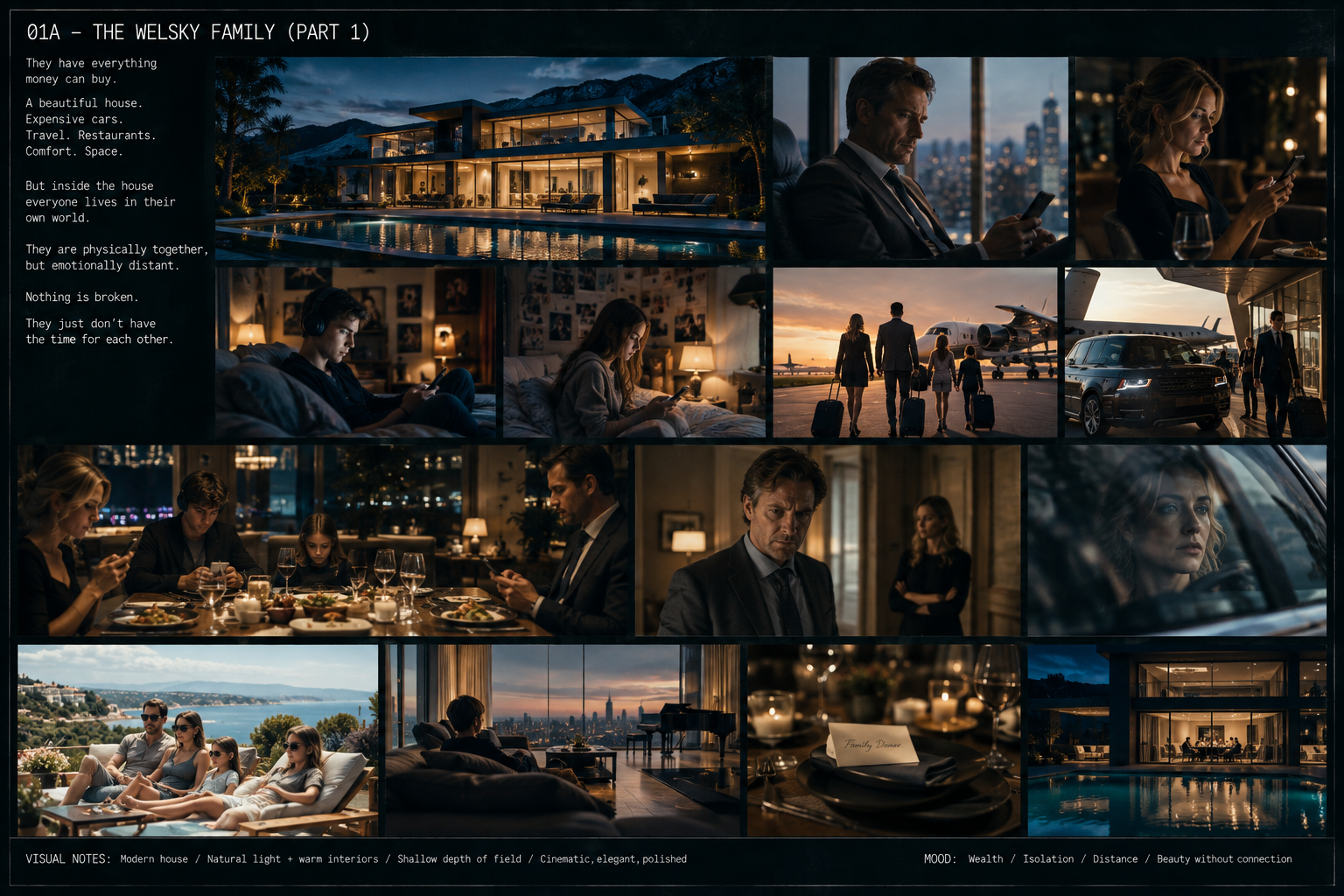
A modern glass house after sunset. The architecture is extraordinary; the atmosphere is almost silent. A father answers work messages at the dinner table. The mother scrolls through her phone; the children are in separate rooms, each immersed in a private screen.

A carefully set dinner brings them into the same frame, but not into the same moment. We hold wide, composed shots, letting the distance between chairs and the empty space of the house do the storytelling. Nothing explodes. No one is a villain. This is emotional absence inside material abundance.

At the end of a beautiful evening, everyone is physically present — yet no one is quite there. The scene cuts not to a consequence, but to its visual opposite.

Camera / visual notes: Locked-off wides, precise framing, cooler dusk outside warm-but-controlled interiors. 32/50mm perspectives; visual distance.
Simple Family — concept moodboard

01B

WHAT THEY ALREADY HAVE

_Part II — The close-knit family_

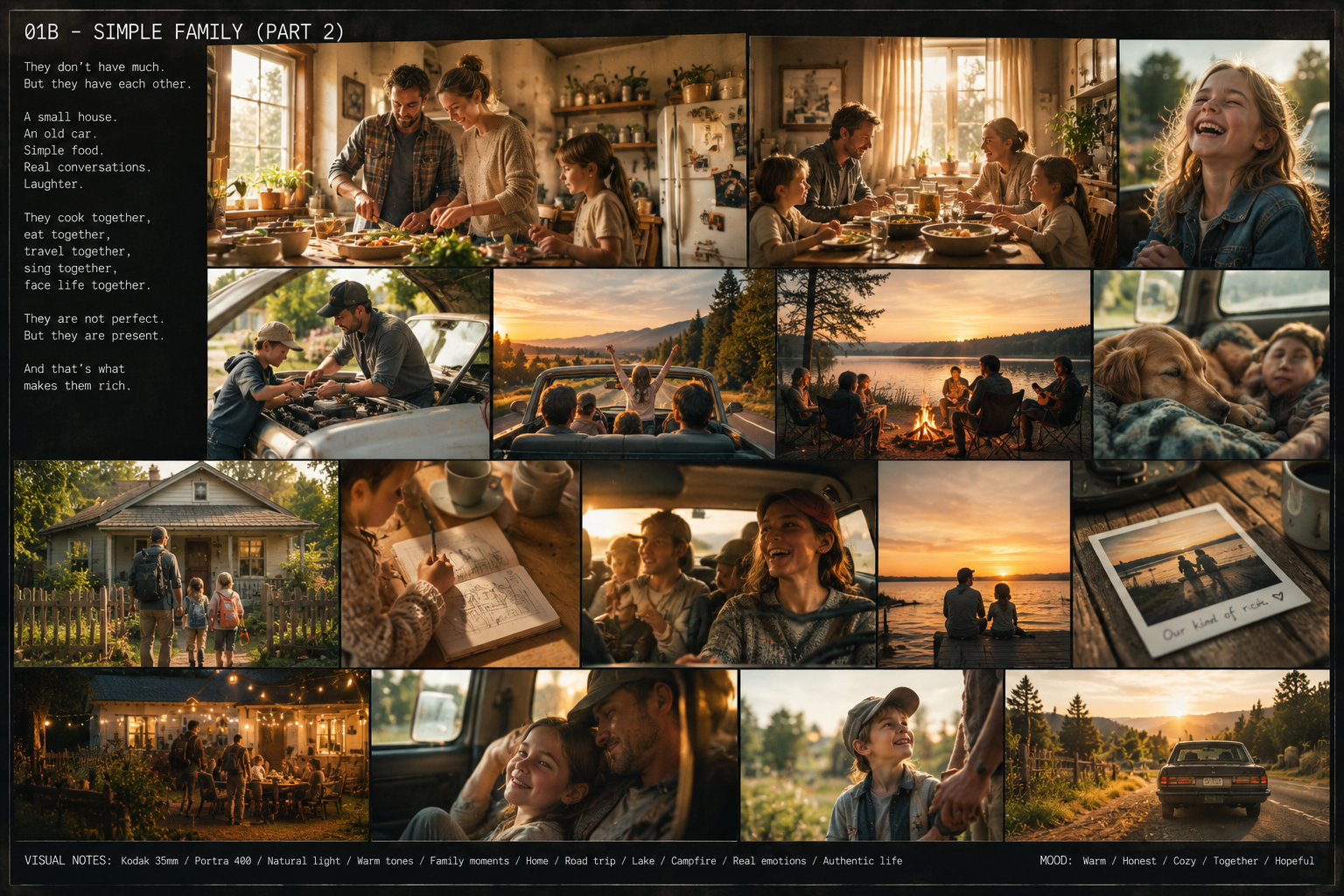
A modest, lived-in home fills with late-afternoon sunlight. The family cooks in a cramped kitchen, bumps elbows, laughs and eats around a small table. Father and child work on an old car; on a weekend drive everyone sings at once.

At a lakeside fire, they pass food around, take a slightly imperfect photograph, lean against one another. These are not heroic moments, nor a declaration that poverty makes people happier. They are simple moments made valuable by attention and shared time.

The camera moves closer than it ever did in the wealthy home: hands, faces, spontaneous gestures, bodies occupying the same frame. One family owns more things. The other is actively living what the first family cannot purchase on demand.

Camera / visual notes: Warm late-day natural light, handheld intimacy, layered compositions, 35/50mm, tactile and unposed.

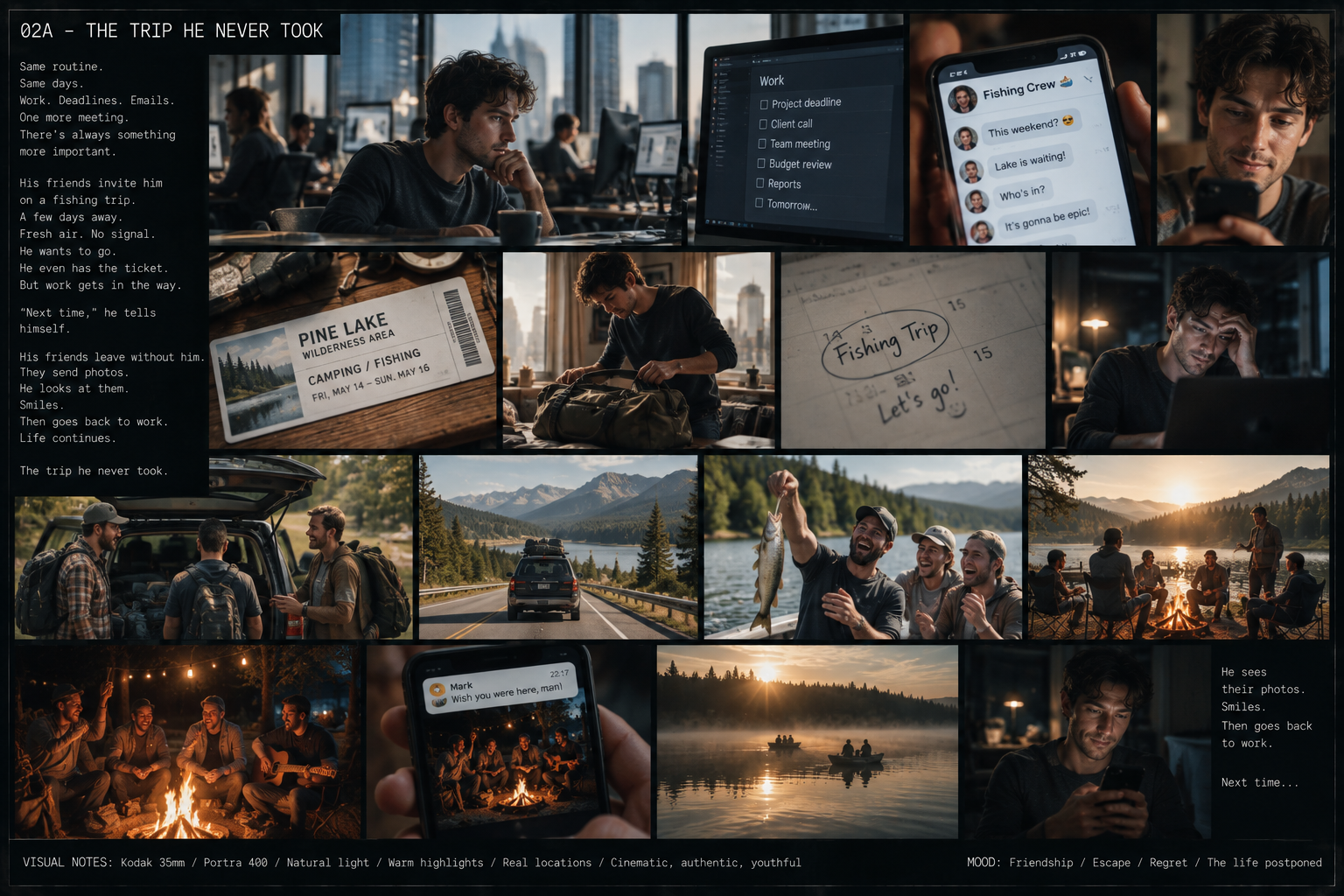
The Trip He Never Took — concept moodboard

02A

THE TRIP HE NEVER TOOK

_Part I — The decision_

A young office worker moves through familiar repetitions: commuter train, coffee, desk, late-night monitor. His friends invite him to a fishing weekend at a lake. He wants to go; he has already paid for a campsite pass and folded it into his jacket.

A deadline appears. He pauses over the packed bag, then sets it aside. “Next time,” he tells himself. His friends load the car and leave without him.

Their trip is full of life: winding roads, a fish held proudly toward the camera, a campfire, mist over the water at dawn. Photographs arrive on his phone while he works under office lights. He smiles, puts the phone down, and opens another work window.

For them it is an ordinary weekend. For him it is the beginning of an absence he cannot yet see.

Camera / visual notes: Contrast fluorescent office rhythm with luminous, handheld outdoor images. The absent friend never appears in the trip.

Years Later — concept moodboard

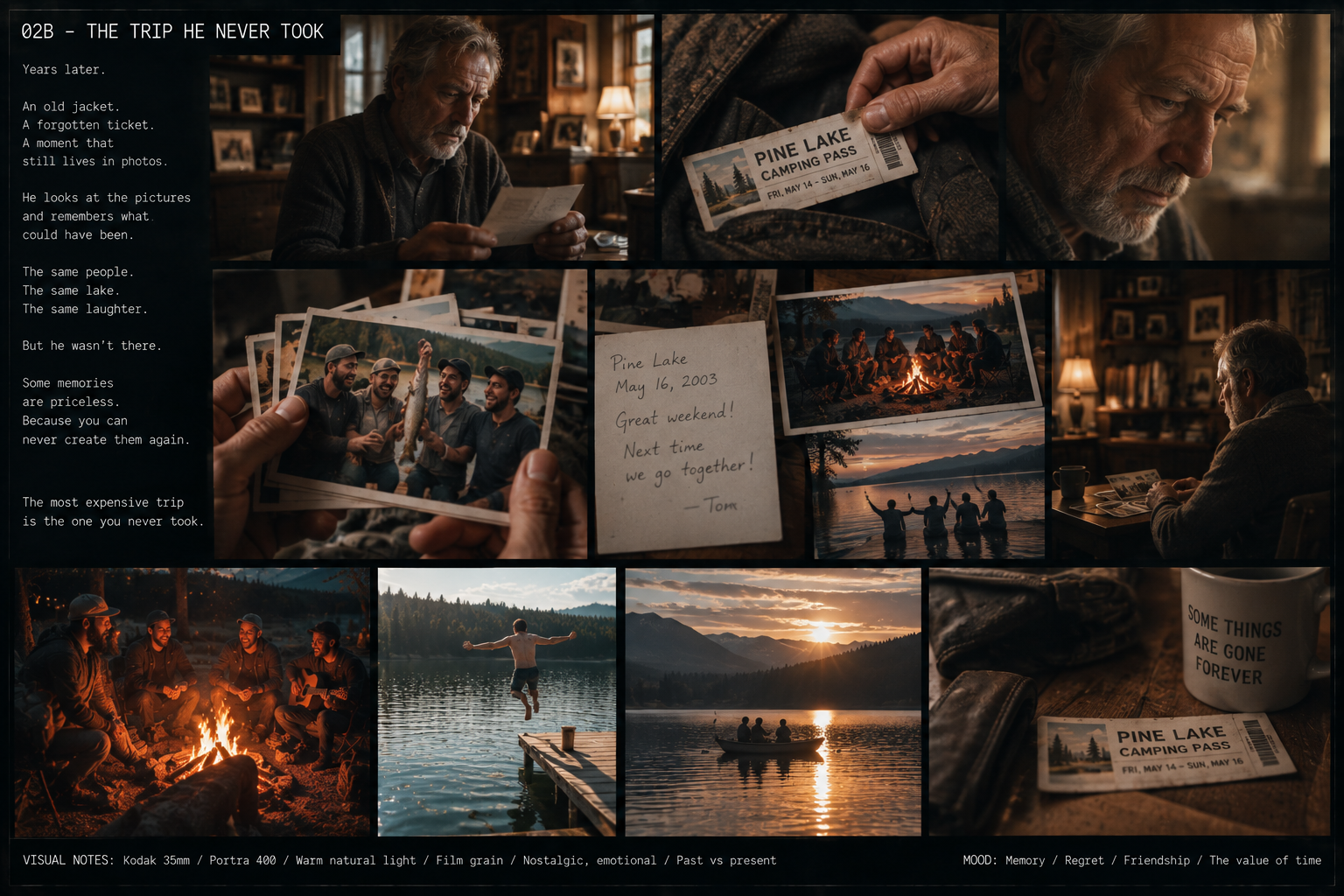
02B

THE UNUSED PASS

_Part II — Years later_

Decades pass without an obvious dramatic rupture. The man, now older, opens a wardrobe and reaches for a jacket he has not worn for years. A folded camping pass slips from the pocket. Same lake. Same date.

Next to it he finds the prints his friends once sent him. We move from the older man’s fingers on the photographs into brief images of the lake and fire. These are imagined fragments of a weekend he knows only through other people’s pictures — never memories of being there.

He looks again at the pass. The price printed on it was small. What it represents is immeasurable.

The most expensive trip is the one you never took. Because you cannot go back and create a memory in the time when it should have happened.

Camera / visual notes: Quiet room tone suggested through close detail. Slow push-ins, aged skin, paper, textile, sunset imagery with no false flashback of him on the trip.

The Empty Chair — concept moodboard

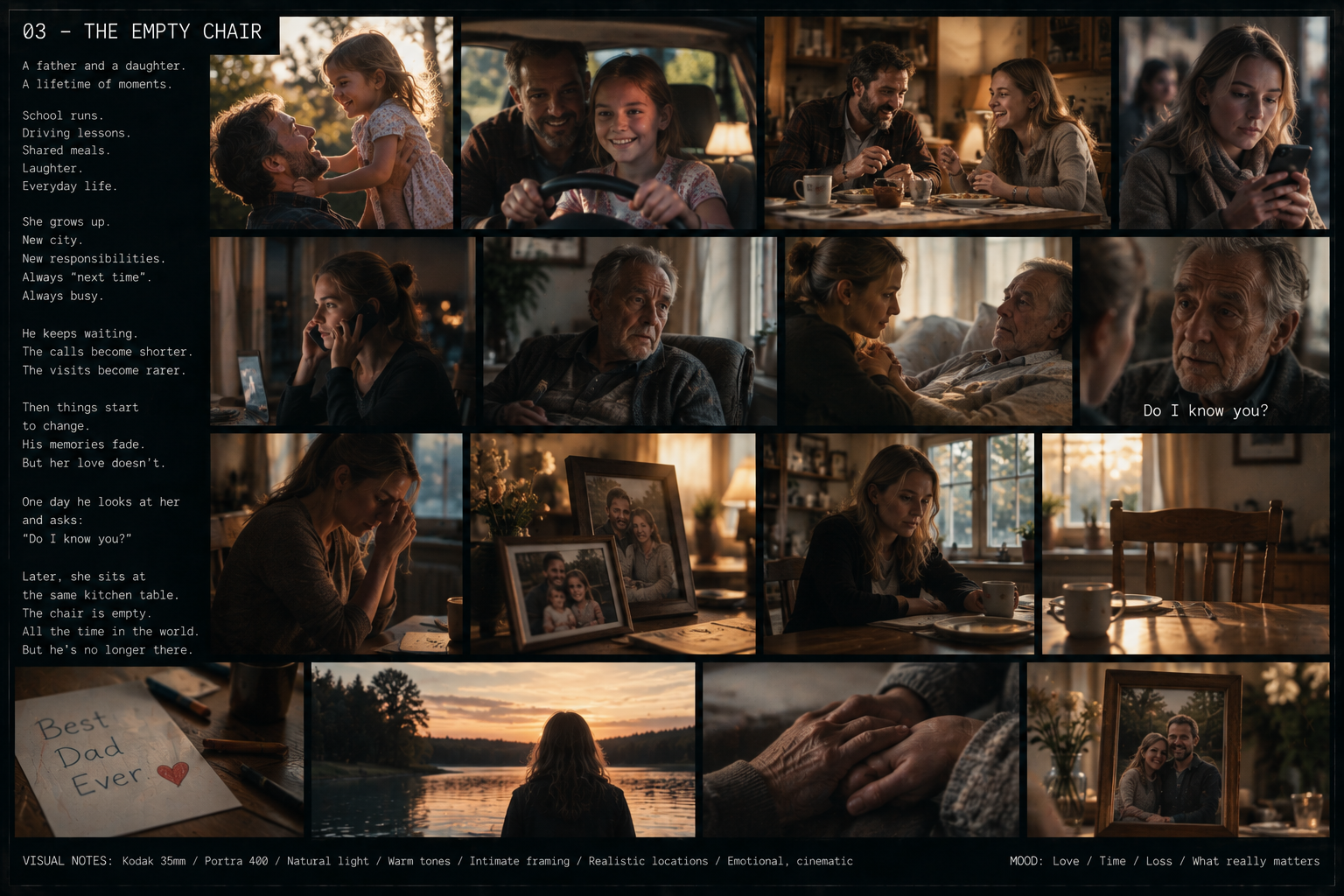
03

THE EMPTY CHAIR

_A daughter and her father_

A father waits outside school, teaches his daughter to drive, and shares late breakfasts with her at a familiar kitchen table. Small repetitions make their relationship feel lived in.

She grows up. Work, travel and responsibility multiply. He calls; she promises to visit. She means it. There is no villain here, only the ordinary habit of thinking there will be another weekend.

Then he begins to forget. At first a date, then a conversation, then a face. She comes to see him more often, sits beside him and holds his hand. One afternoon he looks at her gently and asks, “Do I know you?” She answers, “I’m your daughter.” He cannot place her.

Later she sits at his kitchen table. His chair is empty because he is no longer living there. She finally has time, yet the familiar relationship she postponed cannot simply be resumed.

Camera / visual notes: Recurring compositions of the same table; warm childhood, muted present. Patient close-ups and hands; no medical sensationalism.

The Band — concept moodboard

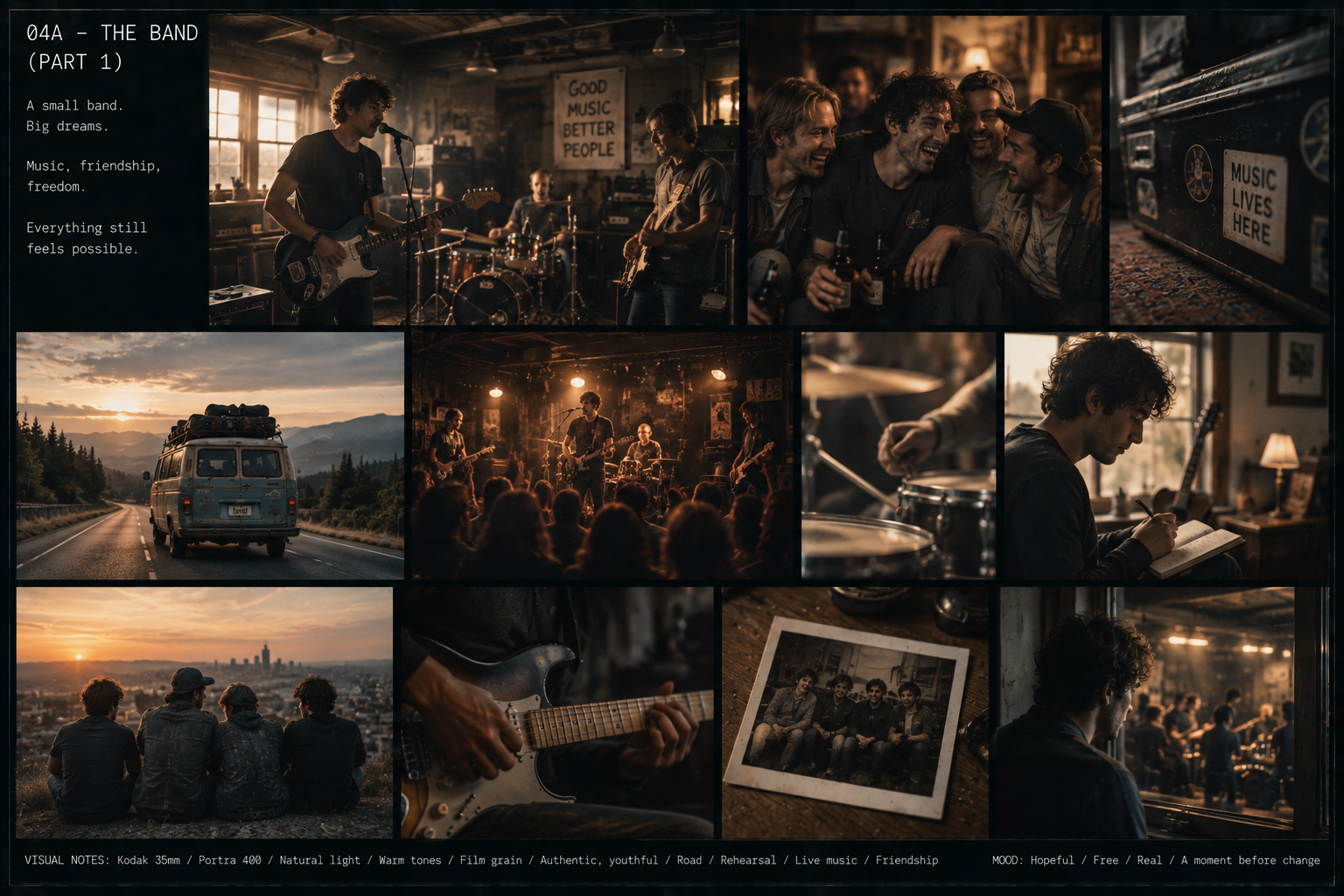
04A

THE BAND

_Part I — Everything still feels possible_

A young man and his friends rehearse in a small, cluttered room. They share a van, play local clubs, write songs, argue over arrangements and laugh at midnight. The music is theirs; the band is fictional and is not a fictional history of Ivy.

We find him most alive in those rooms. Then a steady job offers him a different road. It is not an evil choice: he wants security and the freedom that a reliable income seems to promise.

He tells his friends he will be back. They hug; he carries his guitar case out of the rehearsal space. The band keeps playing somewhere behind him. We end this part before the years pass: what matters is the moment in which an open future narrows into one chosen path.

Camera / visual notes: Warm grain, lively shoulder-height camera, intimate club energy, natural performances.

The Life You Didn’t Choose — concept moodboard

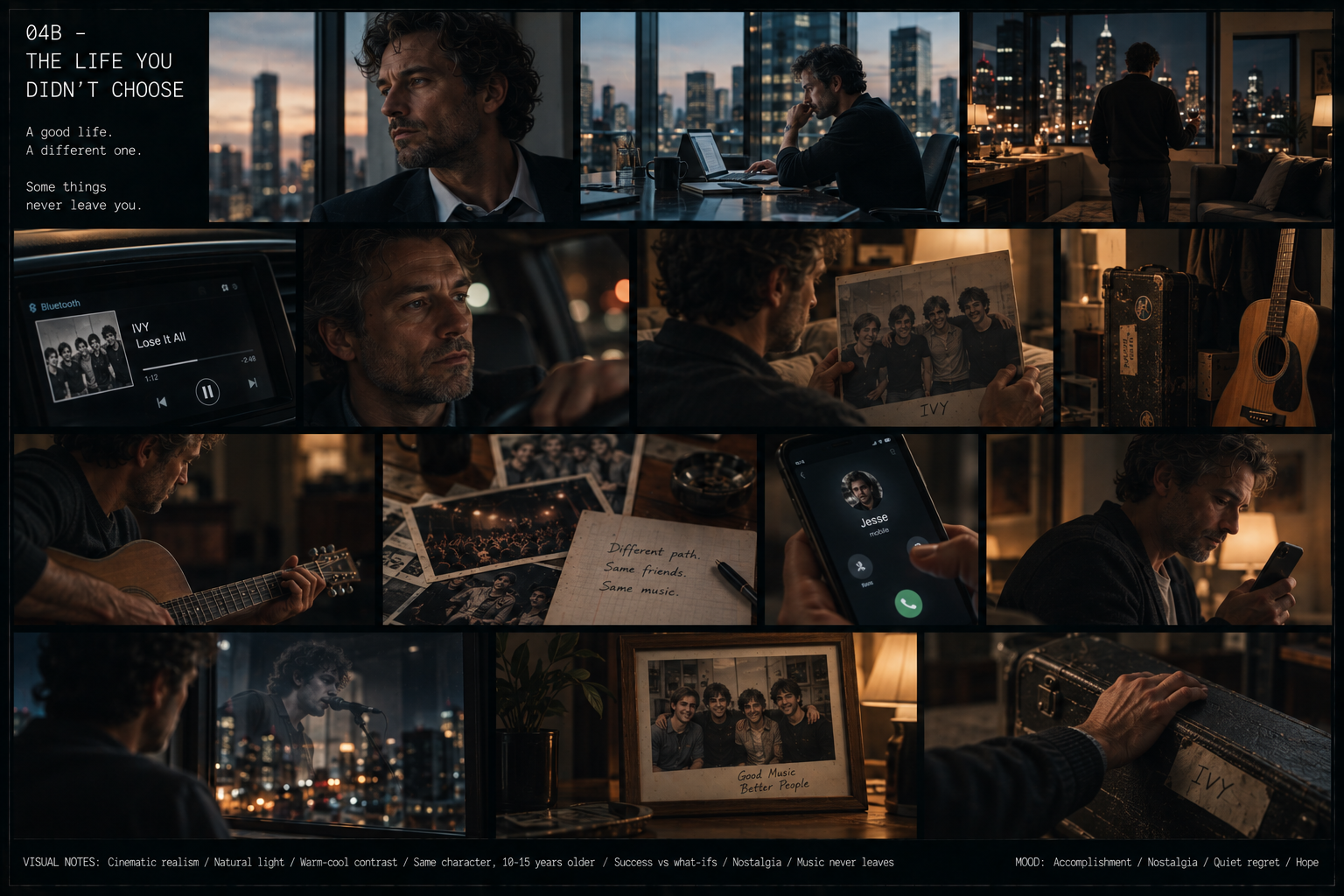
04B

THE LIFE YOU DIDN’T CHOOSE

_Part II — The same man, 10–15 years later_

He has a career, a comfortable apartment and a life that genuinely works. We should never frame him as a failure. Time has simply given him the life he selected.

Driving home, he hears Ivy’s real recording of “Lose It All.” The melody becomes a bridge to the band he once played in. He pulls over for a moment, then later opens the case of his old guitar. A photograph of his fictional band rests beside it.

He tries a familiar phrase. His fingers hesitate; he smiles at himself, surprised by what remains. He finds an old bandmate’s number and hovers over the call button. Finally, he calls.

He cannot undo the years. But his story, unlike the unused pass or his former dream, still has a next move.

Camera / visual notes: Same recognizable actor aged 10–15 years; clear visual match to 04A. Cooler city exteriors, warm quiet guitar scene.

Final Movement — concept moodboard

05A

THE FOUR STORIES BECOME ONE

_The audience — the present moment_

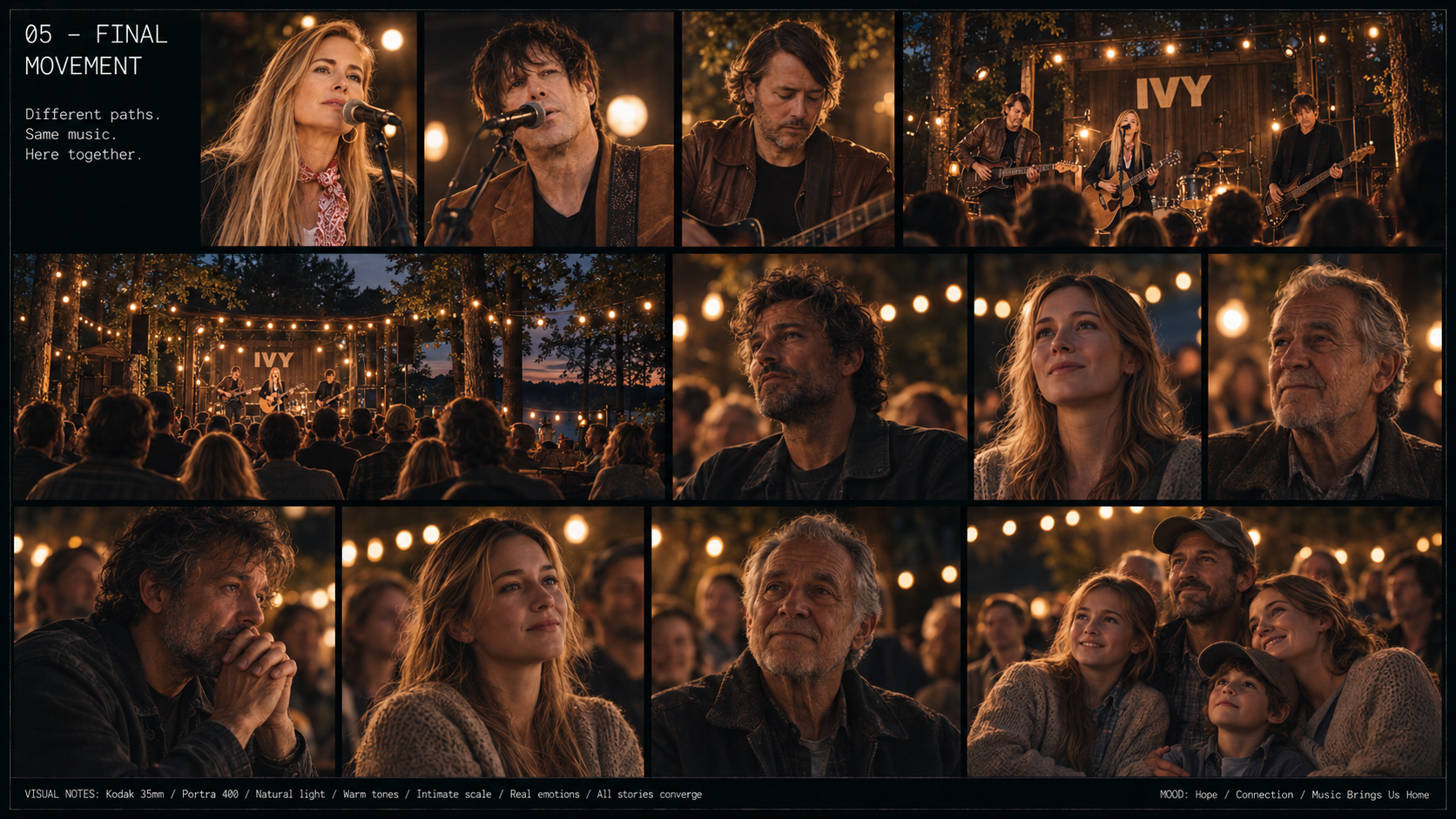
Without an explanatory travel montage, we discover our characters already at an intimate summer open-air concert. The simple family from Chapter 1 stands close, present with one another. The older man with the unused pass watches the stage. The daughter listens alone, carrying a quiet absence. The former musician stands nearby, hearing music from the position of someone who once performed it.

They do not recognize one another and never need to meet. They are not extras, either. We return to their distinct faces and let each response complete a story: a relieved breath, a hand around a child’s shoulder, an attentive gaze, a small smile. The affluent family is not included in this concert sequence.

All four narrative worlds share one unrepeatable moment. None of the past has been repaired. But everyone is here, now.

Camera / visual notes: A restrained summer-stage environment, real-feeling front-row portraits, available warm practicals, no staged lighters or sentimental posing.

Ivy Live Performance — concept moodboard

05B

IVY — LIVE PERFORMANCE

_The music at the center of the film_

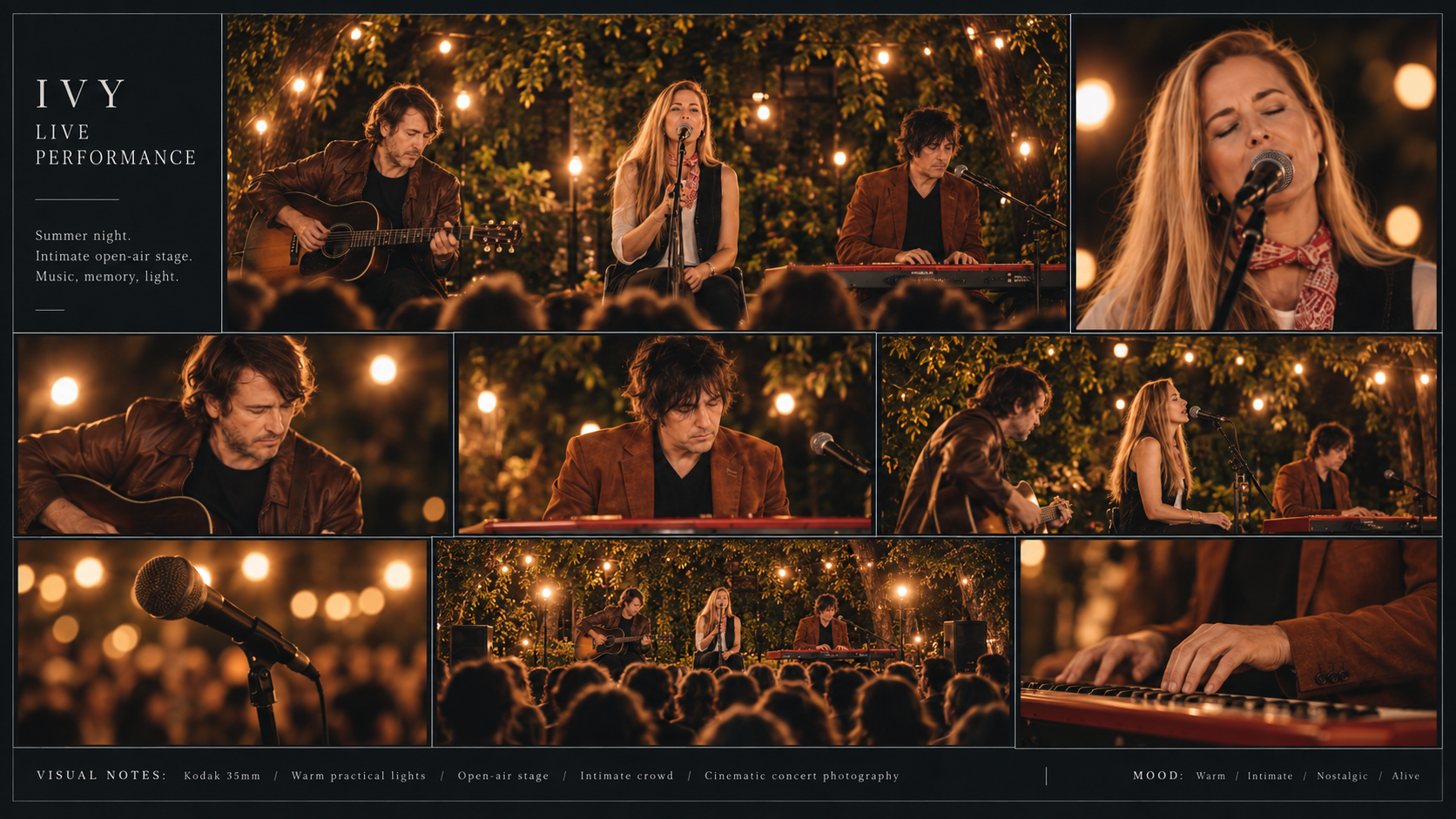
The performance belongs to Ivy rather than becoming a fifth fictional story. Dominique Durand sings at the microphone; Andy Chase plays guitar; Bruce Driscoll plays guitar or keyboards according to an agreed live arrangement. Our visual proposal uses keys for Bruce. These are the three featured Ivy members on the board; no extra featured player is invented.

The camera begins with a close, unforced portrait of Dominique, catches Andy’s hands and Bruce’s playing, then opens out to reveal the stage among trees. We intercut with our audience characters and, sparingly, with very short visual echoes from their stories: the lake, the kitchen table, the youthful rehearsal room.

The last movement is not a lesson about regret. It is a gentle invitation to be present. The final wide shot holds the band and the audience in the same pool of evening light. Music, for this moment, has brought separate lives together.

Camera / visual notes: Staged portrait coverage: 50/85mm for faces, 35mm for stage, selective long lens through soft practical light.

Key Visual Moments

Key Visual Moments

The Two Tables

One family has everything but connection. Another has very little, yet shares everything that matters.

The Weekend

Friends laughing beside a lake. A photograph captures everyone except the man who chose to stay at work.

The Ticket

Decades later, a forgotten ticket falls from an old jacket. A moment that never happened becomes priceless.

The Empty Chair

A daughter finally finds time for her father. But the man sitting across from her no longer recognizes her.

The Guitar

A successful man discovers his old guitar. For a moment, he confronts the musician he might have become.

The Summer Concert

Ivy performs beneath the warm lights of an intimate open-air stage. Four separate stories finally share one present moment.

The Emotional Arc

The Emotional Arc

The film begins with people who believe they have all the time in the world.

They pursue success, postpone ordinary moments, and make choices for a future that always seems just ahead.

Years pass. What once seemed insignificant becomes irreplaceable.

An unused ticket. An empty chair. A forgotten guitar.

Each object carries the weight of something that cannot be recovered.

But the film does not end in regret.

At an intimate summer concert, Ivy brings these separate lives together. The past remains unchanged, yet something has shifted.

For the first time, our characters are no longer looking backwards or waiting for later.

They are simply here.

We cannot return to the life we had. But we can still recognize the life we have.