AI69 Production · Music Video Treatment
My Will to Live
A descent through an endless industrial labyrinth where survival itself may be the trap.
Prepared for Obituary The Concept
Survival inside an endless industrial hell
“My Will to Live” is a dark cinematic horror film built as a journey through an abandoned underground labyrinth filled with nightmare scenes, industrial spaces and surreal anomalies.
The protagonist wakes inside a dark concrete complex and begins searching for a way out. He cannot remember how he got there, does not understand what this place is, and can rely only on his instinct to survive.
As he moves through corridors, stairwells and chambers, he witnesses horrific scenes behind closed doors and grates — rituals, experiments, signs of madness and the destruction of human nature.
As the journey continues, the labyrinth stops feeling like merely physical space. It begins to live by its own rules. The rooms feel like fragments of one vast nightmare, where reality fractures and the protagonist increasingly encounters traces of his own presence.
Obituary exists inside this world as well. The band does not arrive as a separate concert intercut, but as part of the space itself — as if the music comes from the heart of the labyrinth and sets it in motion.
This is not a literal illustration of the lyrics, but a complete horror film in which the title “My Will to Live” becomes a story of survival inside an endless industrial hell.
Visual Language
Industrial horror, psychological pressure, surreal rupture
The film should feel like harsh industrial horror with elements of psychological thriller and surrealism.
Cold concrete, wet surfaces, rust, metal doors and grates, industrial corridors, weak fluorescent lamps, deep shadow, smoke, steam and dirty air.
The camera often follows the protagonist from behind, periodically shifting into first-person view, as if inside a survival-horror game.
Inside the rooms of horror, the camera is tense and observant, as though the protagonist is afraid to breathe too loudly.
In the performance scenes, the camera becomes more aggressive, dynamic and rhythmic.
The light is predominantly cold and dirty, with deep shadows. Isolated ritual and music scenes introduce warmer sources of light. Every scene must feel like part of one film, not a collection of disconnected horror references.
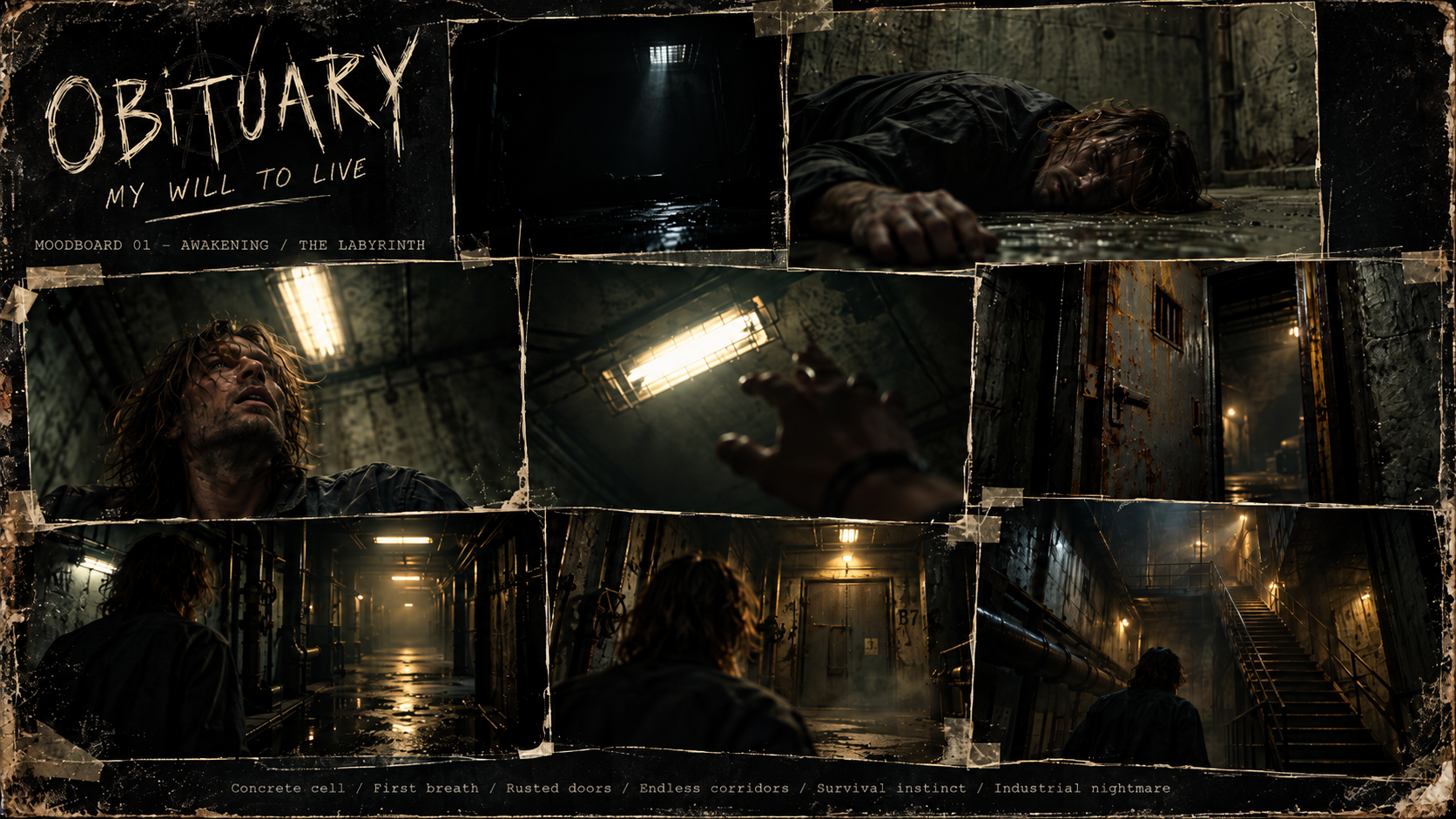
01 Awakening
The film opens in complete darkness.
First we hear breathing, water dripping and distant metal noise. Then, in the weak light of a flickering lamp, a small concrete cell begins to appear.
A man lies on the floor. He slowly regains consciousness, tries to stand, looks around and attempts to understand where he is.
The cell door is not fully locked.
He steps outside and sees the abandoned underground complex for the first time — endless corridors, stairwells, pipes, metal doors, wet concrete and darkness.
His journey through the labyrinth begins here.
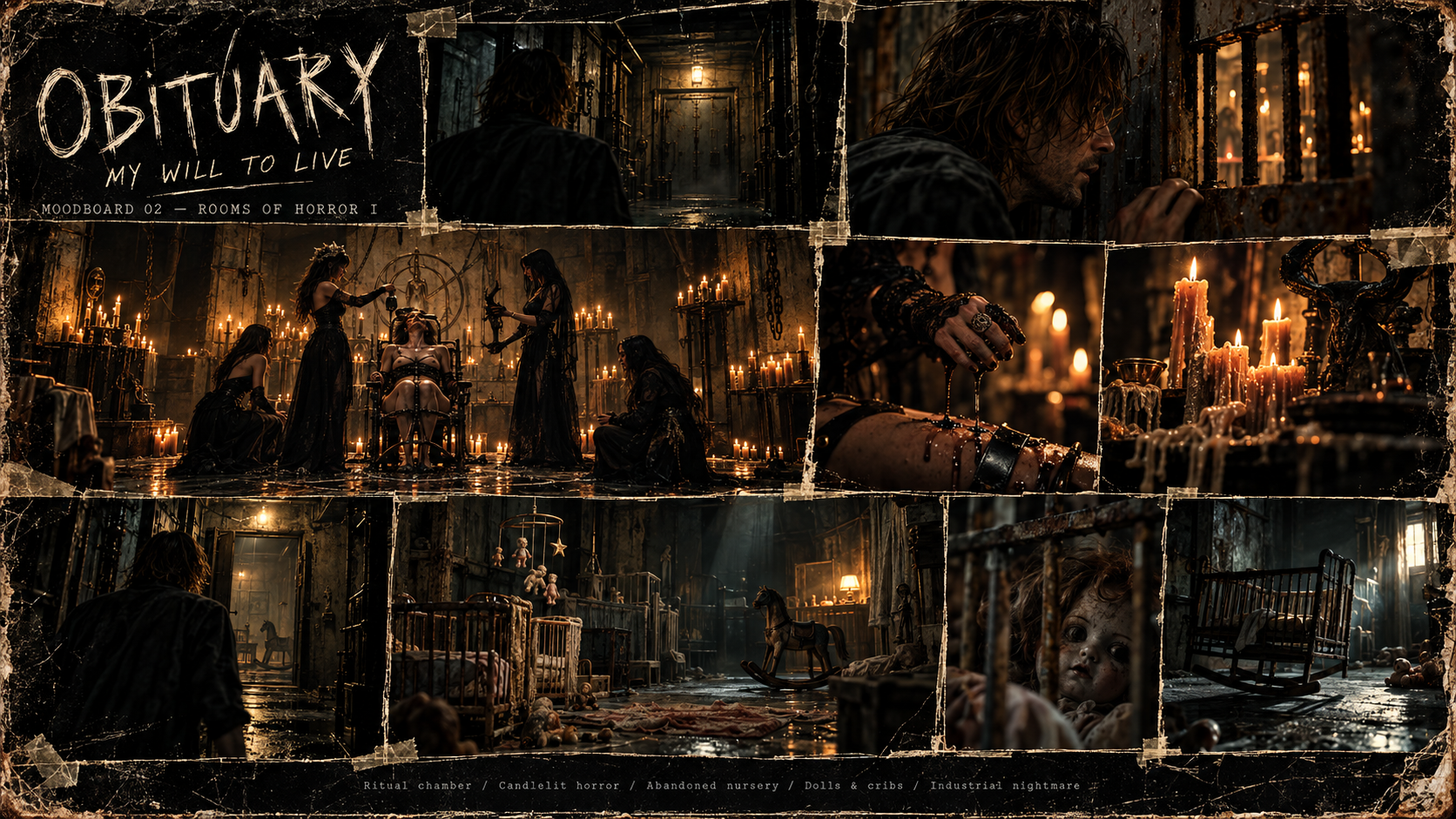
02 The Labyrinth: Rooms of Horror I
He moves forward, cautiously exploring the space. He hears strange sounds behind doors, stops, listens, looks through grates, pushes doors open and becomes a witness to nightmare scenes.
In a half-dark room lit by candles, several women in black perform a strange ritual around a bound person strapped to a metal chair. Wax drips onto the prisoner’s body. The women move calmly, slowly, almost ceremonially. This is not chaos, but controlled, cold horror.
Behind another door, he finds a disturbing nursery hidden among industrial walls: old cots, porcelain dolls, a wooden rocking horse, toys scattered across the floor.
One cot begins to rock on its own. Several dolls turn their heads toward the door.
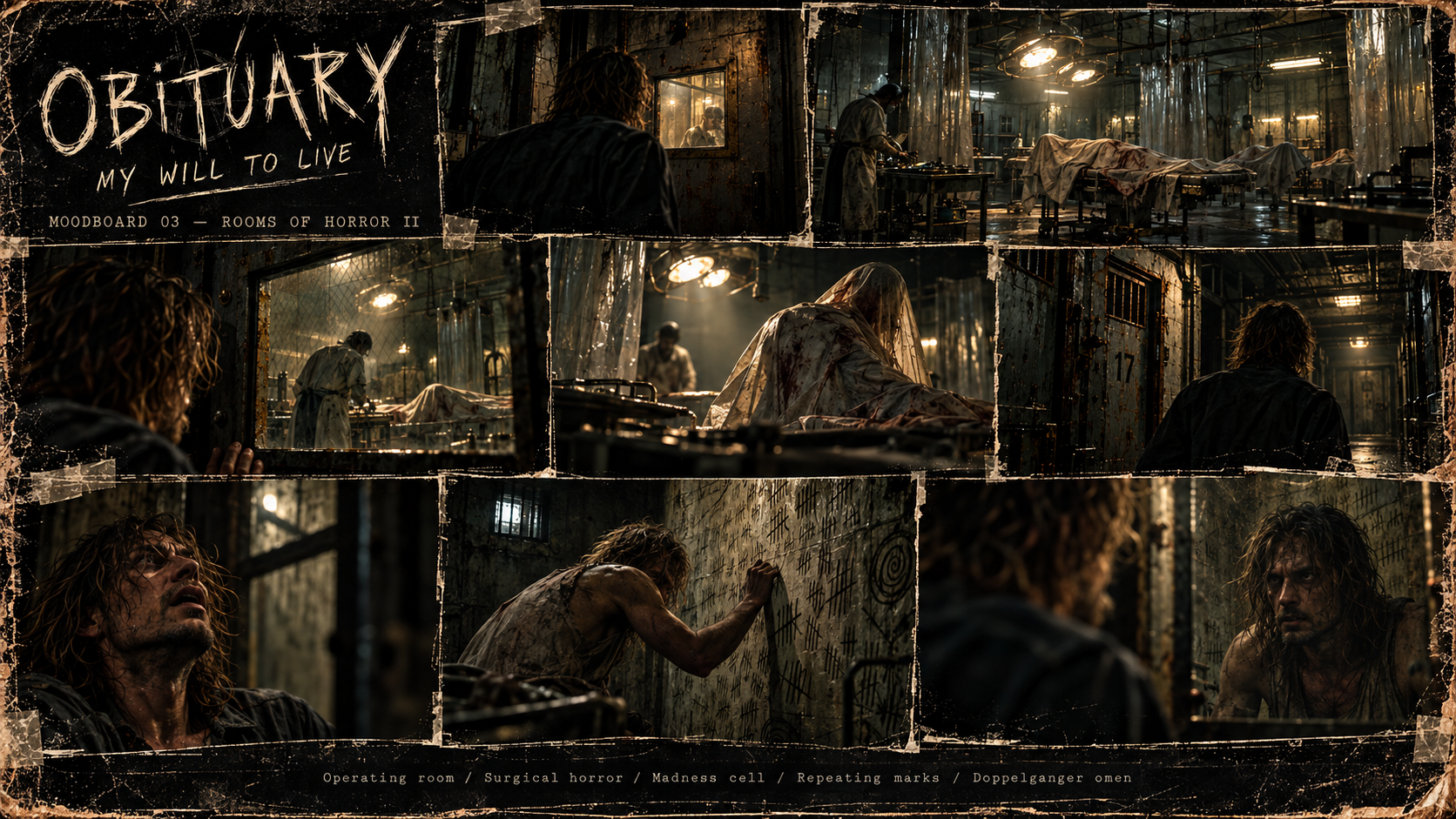
03 The Labyrinth: Rooms of Horror II
The next space resembles an old underground laboratory or operating ward: rusted instruments, metal tables, soiled curtains and bodies covered in sheets.
A figure in a dirty medical apron works in the shadows. One of the figures on the operating table begins to move.
In a narrow concrete cell, someone sits scratching at a wall covered in repeating symbols and marks. When the protagonist looks inside, the prisoner turns — and for a moment seems to be him.
These scenes need no literal explanation. Their force lies in the sense that every door conceals a different form of horror, yet all of it belongs to one world.
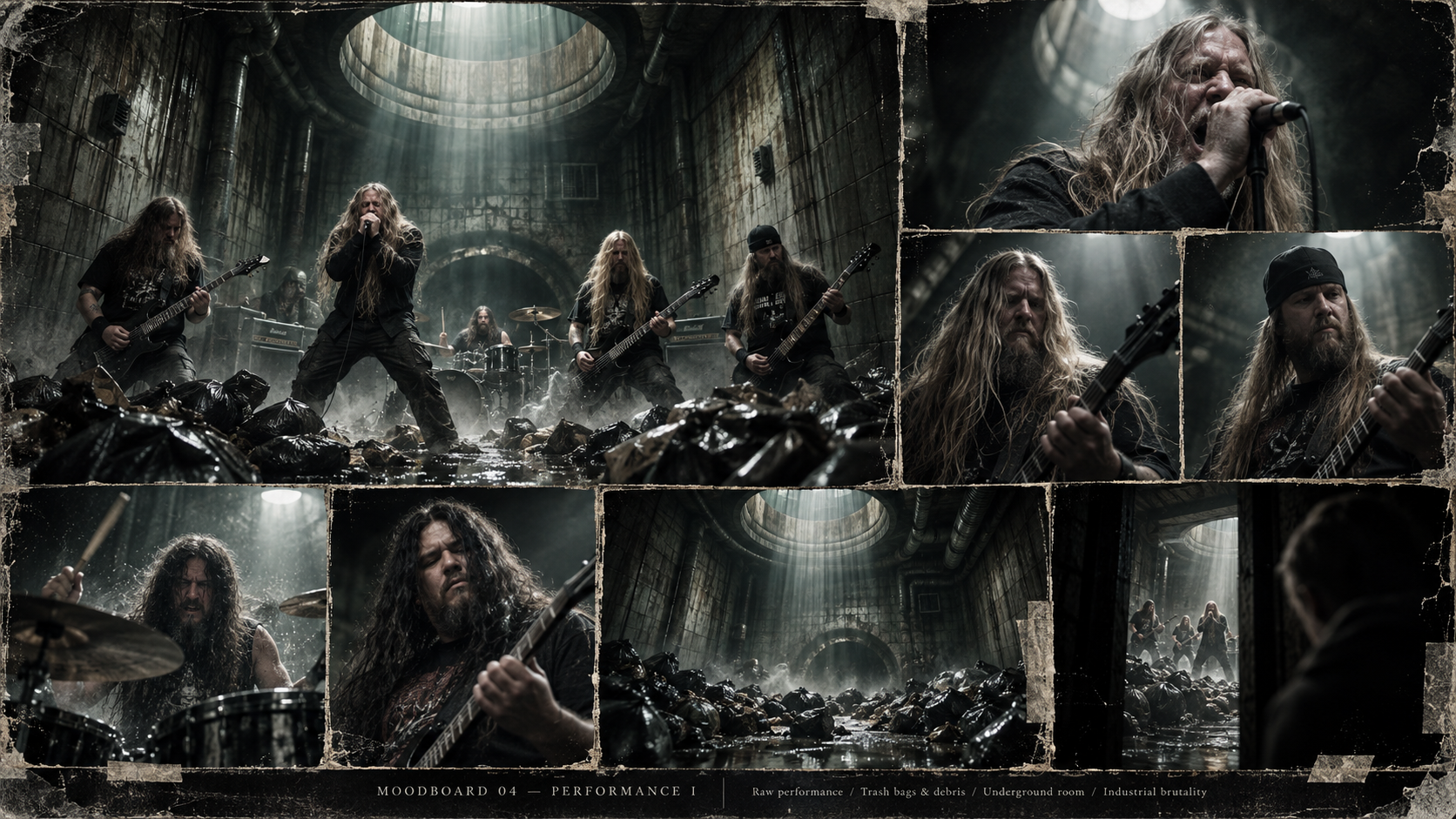
04 Obituary — First Performance
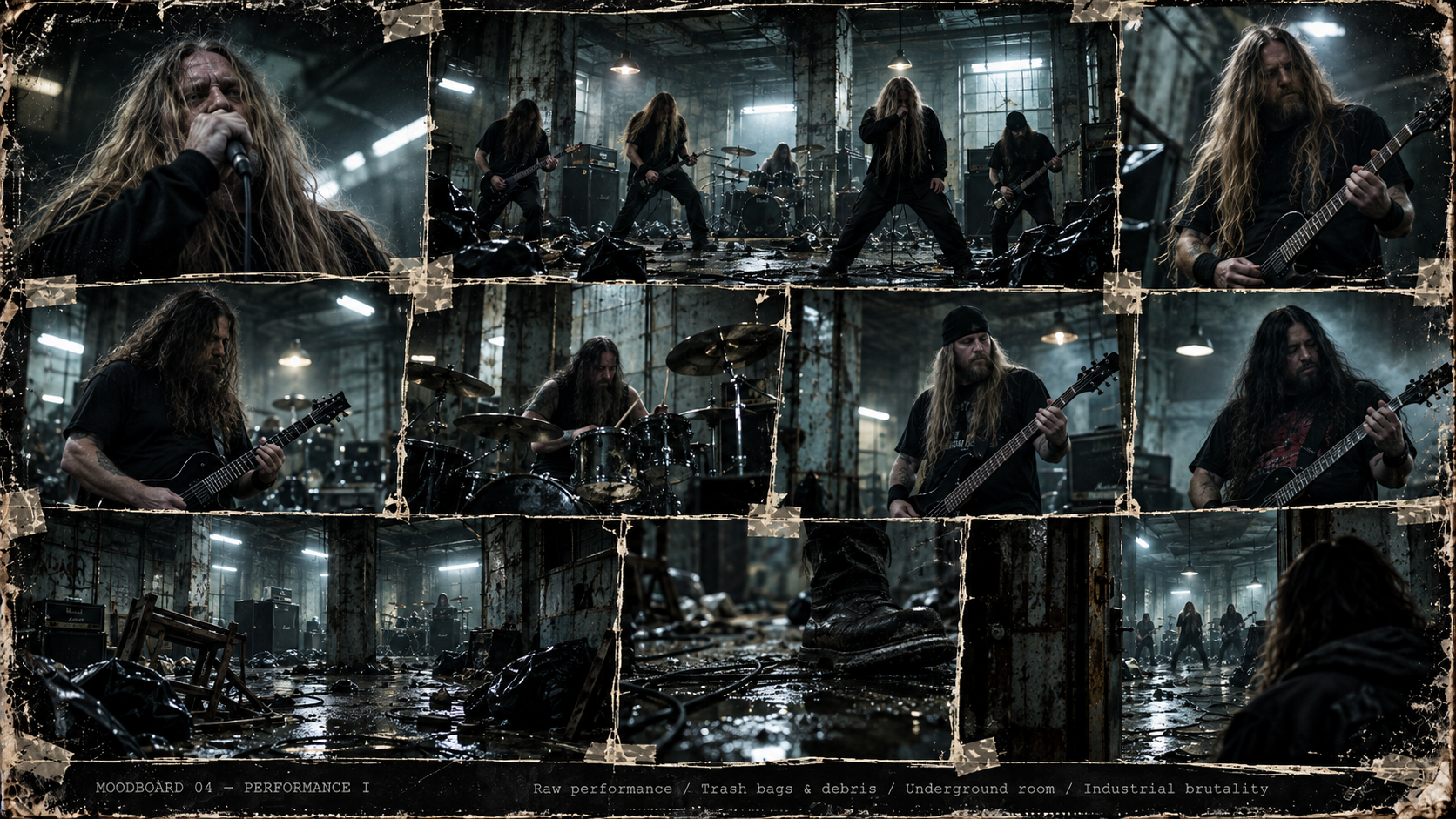
The first performance space is a rough, chaotic, filthy room inside the complex.
The band plays among rubbish bags, junk, discarded equipment and metal structures.
It is not a concert stage, but a space that feels discovered inside an abandoned industrial zone.
The music feels raw and animal, coming directly from the building’s depths.
The protagonist may first see the band through a doorway or watch the musicians from the neighbouring corridor. The performance becomes part of the labyrinth itself.
05 Living Walls
This is one of the film’s defining visual moments.
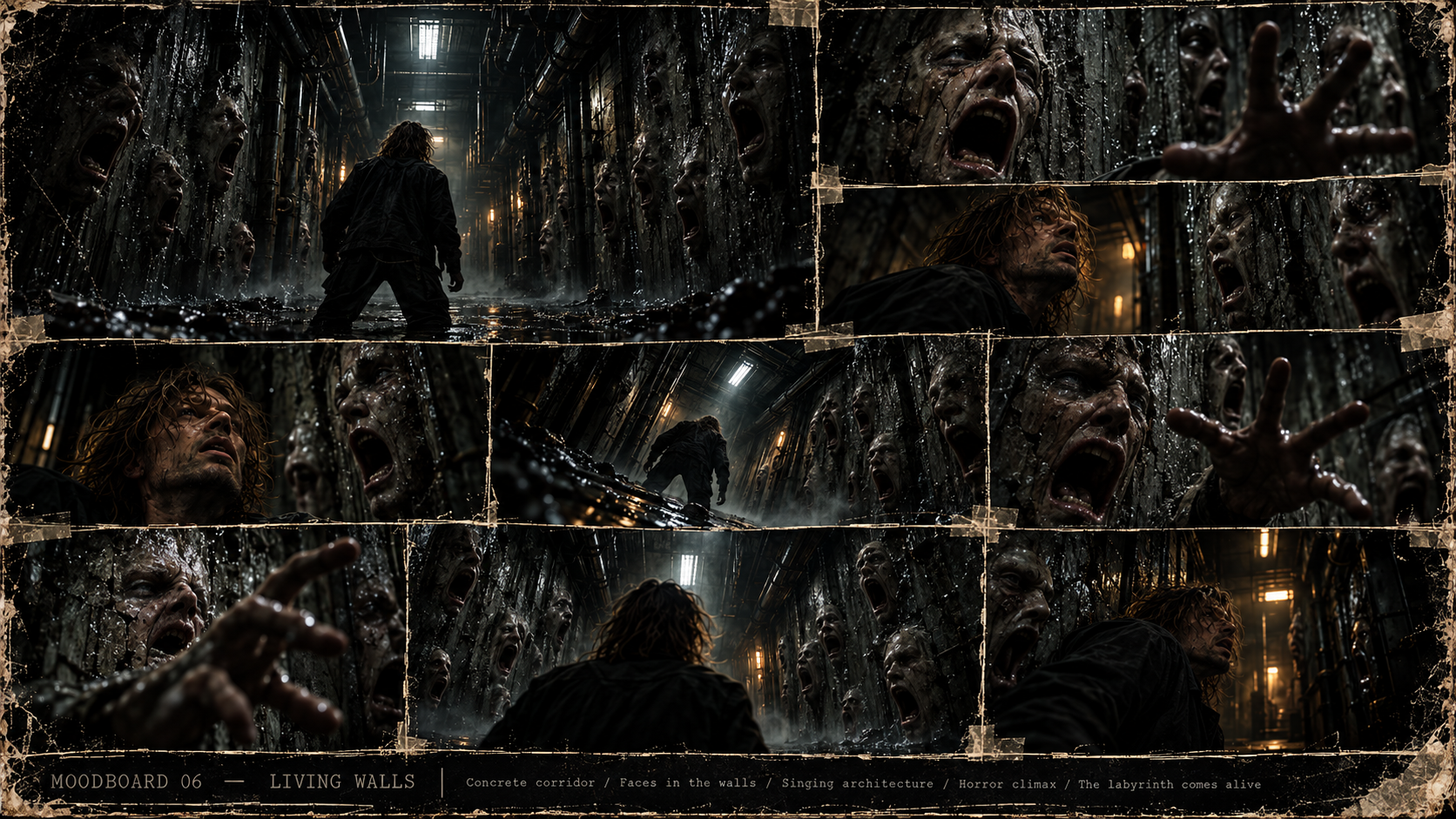
The protagonist enters a narrow corridor where the walls initially seem merely damp and cracked.
Gradually, human faces begin to emerge from the concrete. One. Then another. Then dozens.
It feels as though people have been walled alive into the structure of the labyrinth itself.
At one of the song’s most powerful vocal moments, the faces open their mouths together and begin to growl in unison with Obituary — as if the architecture itself is singing with the band.
It must never become comic. It is a living chorus of pain, where the music literally travels through the walls. The sequence is one of the film’s principal horror climaxes.
06 Obituary — Second Performance
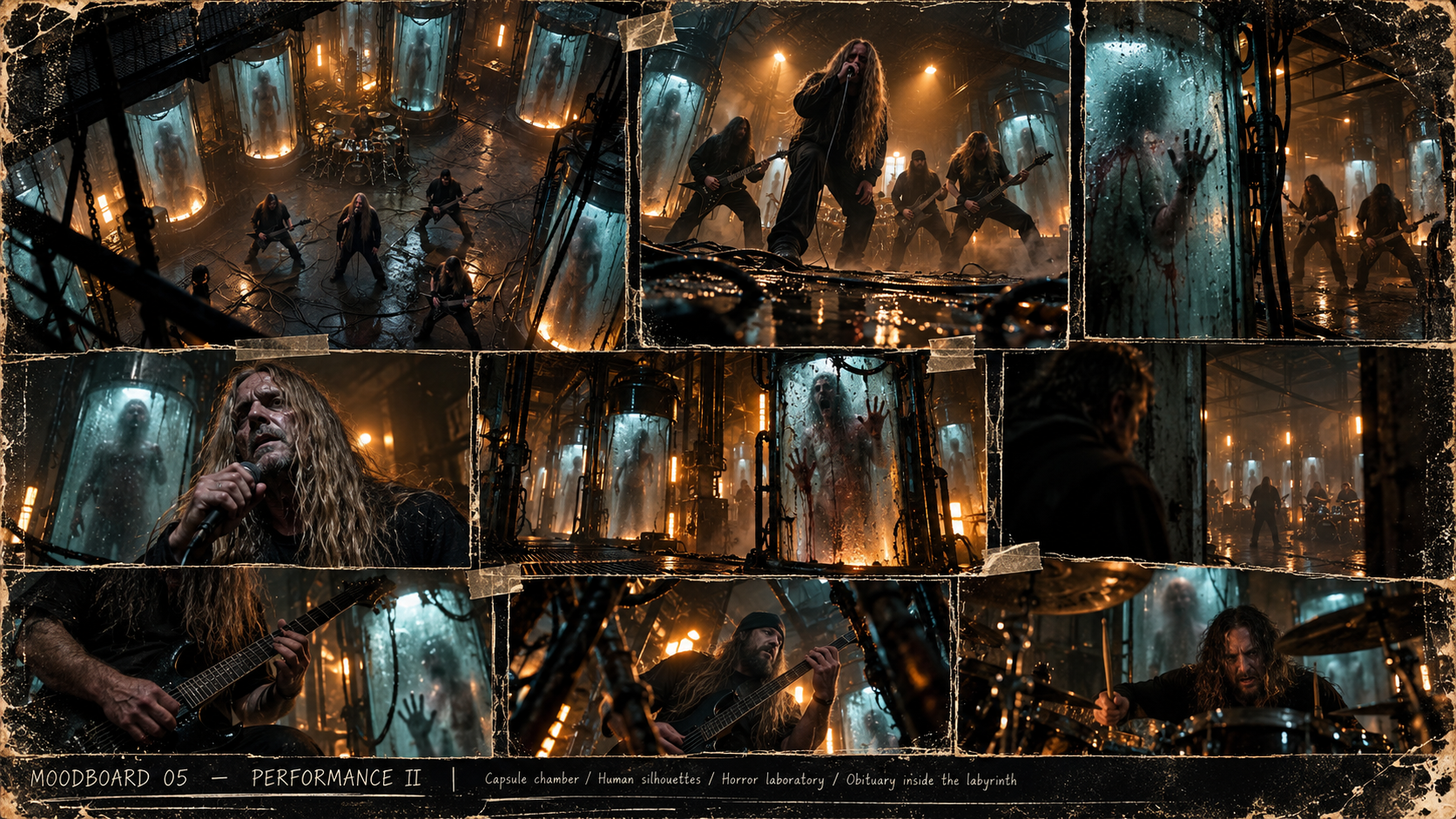
The protagonist discovers another room inside the complex: a dark industrial hall resembling a secret laboratory. Obituary performs here again.
Behind the musicians rise vertical transparent capsules containing human figures. They appear to be stored, grown or subjected to unexplained experiments.
Warm backlight on the musicians contrasts with the cold bluish glow of the capsules. Movement is visible behind the fogged glass; in one capsule, a figure presses a hand against it.
The camera moves between overhead views from a technical gallery, low angles, shots through steamed glass, close-ups of the musicians and details of the capsules.
The environment must read as a horror laboratory inside the abandoned complex, never as a clean futuristic space. Both performance locations exist within one world, yet remain visually distinct and can be intercut with the story throughout the film.
07 Traces of Himself
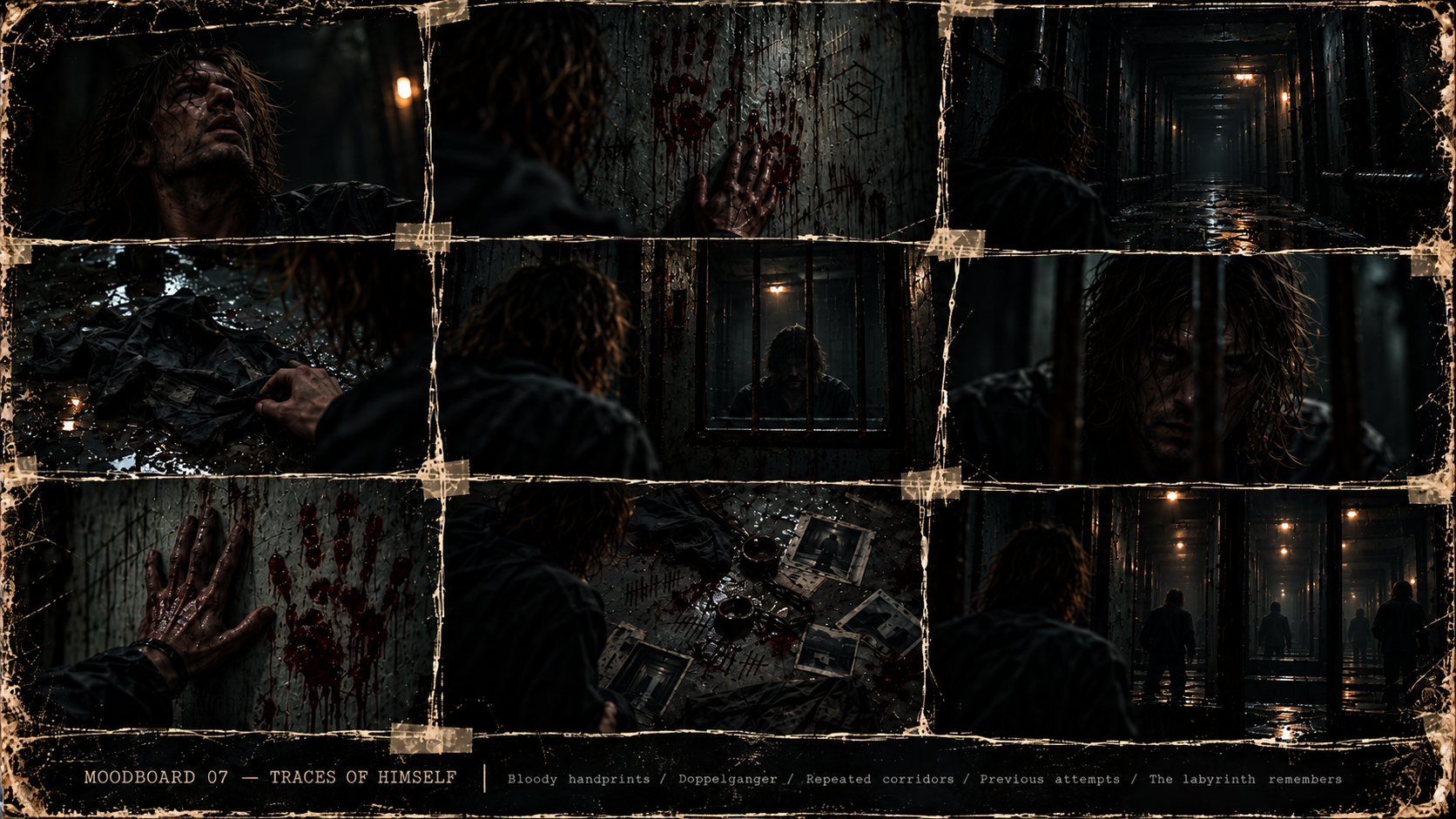
The further he goes, the stronger the sense that he has been here before.
He notices familiar handprints, signs of struggle, fragments of clothing like his own, doors that look as if he has already tried to open them, and repeating sections of corridor.
Inside one chamber, he sees a figure that looks exactly like him. The double raises its head and looks directly at him.
From this point, the labyrinth becomes not only a place of external horror, but a space of personal nightmare.
It is unclear whether he is walking through the complex for the first time — or repeating the same path without end.
08 Finale — Endless Cycle
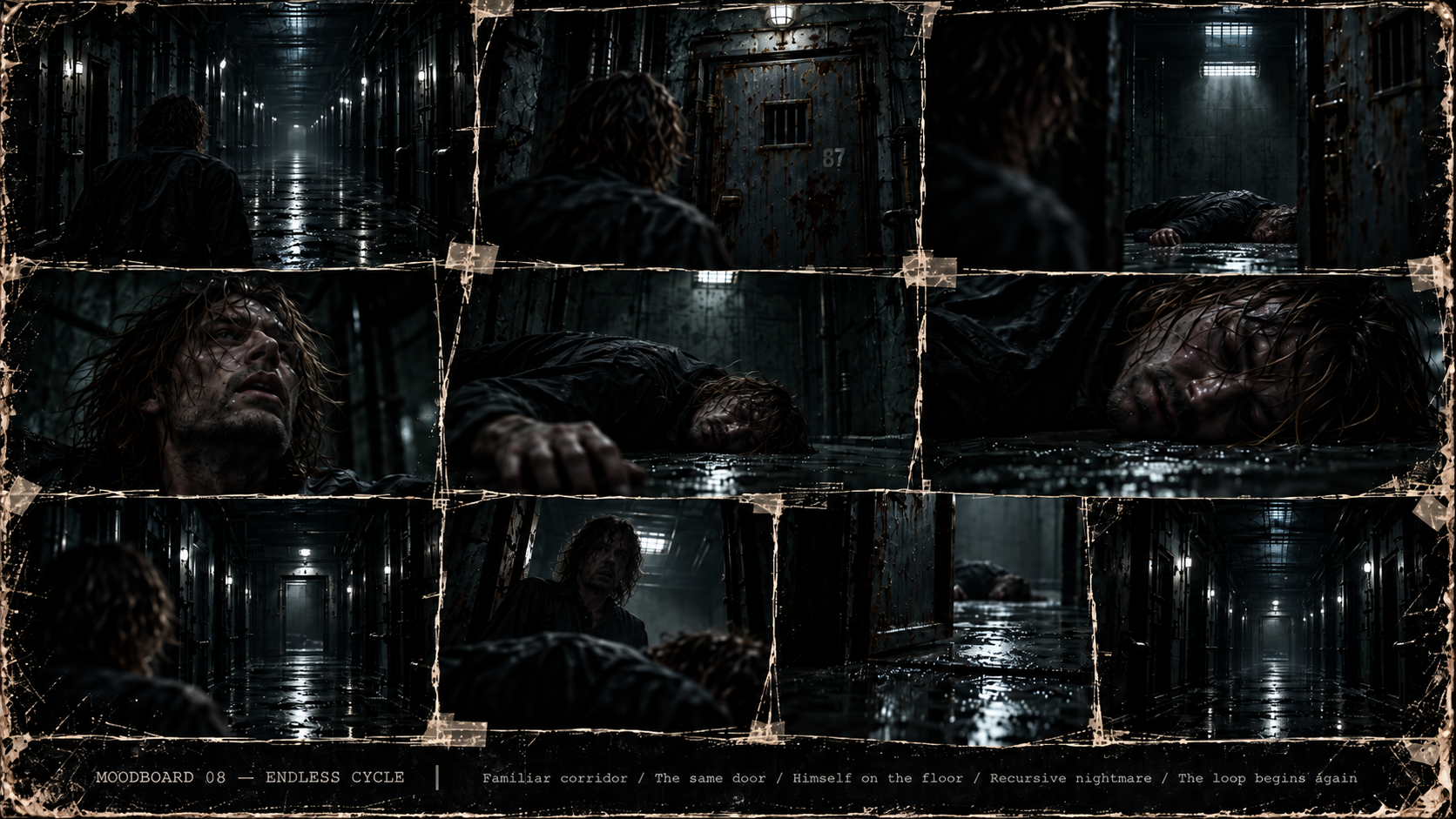
He passes through another metal door and enters a corridor that feels terrifyingly familiar: the same pipes, the same lamp, the same cell at the end of the passage.
He stops. Ahead is the door of the cell where he woke at the beginning of the film.
The man slowly approaches and looks inside. A motionless person lies on the concrete floor.
He recognises himself.
The man on the floor suddenly opens his eyes. Hard cut to black.
Perhaps he never left the labyrinth. Perhaps his fight for life repeats forever. The ending does not close the story; it intensifies its central idea: the will to live keeps him moving, even if the labyrinth itself is doomed to begin again and again.
Why It Fits Obituary
A world built from the weight of the track
This concept works for Obituary because it does not attempt to explain or illustrate the lyrics literally. Instead, it translates the track’s weight, aggression, darkness and physical force into a powerful cinematic world.
The video brings together the aesthetics of a death-metal horror film, an industrial nightmare and a psychological survival thriller. Two memorable performance locations integrate the band into the story.
The living-wall sequence, growling with the vocal, directly connects the music to the reality around it. “My Will to Live” becomes the story of a man who continues fighting for life inside a world where death itself has become architecture.